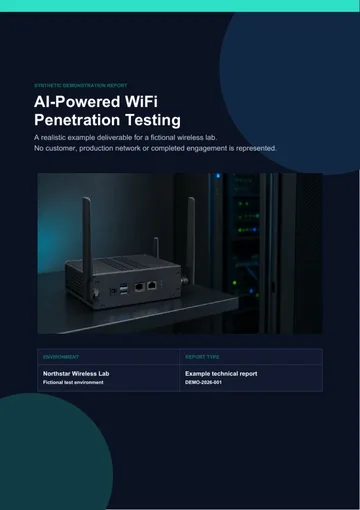
Reaches beyond your walls
Radio signals do not stop at the building line, giving attackers proximity without physical entry.
The complete service
An authorized, expert-led assessment of your wireless infrastructure — how it would hold up against a realistic attacker, and exactly what to fix first.
Wi-Fi penetration testing is an authorized security assessment of your organization's wireless infrastructure. It evaluates how access points, authentication, encryption, segmentation and client behaviour would withstand a realistic attacker — and turns the results into prioritized, actionable remediation for your team.
Wireless is often the least-tested part of an enterprise network, yet it extends the attack surface into car parks, lobbies and neighbouring units. A structured wireless penetration test replaces assumptions with evidence.
Wireless risk
Radio signals do not stop at the building line, giving attackers proximity without physical entry.
Corporate, guest and operational devices frequently share wireless space and need strong separation.
Access points multiply, configurations change and shadow radios appear between formal reviews.
Assessment scope
Techniques marked “Authorized only” are performed solely when explicitly authorized in the signed rules of engagement. No technique is included in every engagement, and no active testing begins without written authorization, defined scope and agreed safety limits.
Common classes of weakness
Described at a high level for awareness — not as instructions. Findings are always validated and contextualized for your environment.
WPA2-Personal networks protected by guessable or shared passphrases that resist little against dictionary attacks.
Unsanctioned or impersonating radios that extend or mimic your network and can expose traffic or credentials.
Guest, corporate and IoT traffic that is insufficiently isolated, allowing lateral movement across the wireless estate.
802.1X/EAP deployments with certificate-validation or configuration weaknesses that undermine strong authentication.
Networks where connected clients can reach one another directly, increasing the blast radius of a single compromise.
Guest networks and portals that leak information or provide an unexpected foothold toward internal systems.
Deliverables
Intended for: Security teamsInfrastructure teamsNetwork engineersRemediation owners
Intended for: C-suite leadersDirectorsRisk committeesNon-technical decision-makers
Customer preparation
No testing begins until written authorization is complete and the rules of engagement are signed.
Industries
Industrial wireless links, OT/IT convergence and machine connectivity expand the attack surface across large plant floors.
Connected medical devices, mobile clinical workstations and guest access must stay isolated from patient-care networks.
Branch and corporate wireless networks carry sensitive data and face strict regulatory and segmentation expectations.
Point-of-sale, inventory scanners and public guest Wi-Fi share physical space and demand strong network segmentation.
High-density guest Wi-Fi, captive portals and property-management systems create rogue-AP and impersonation risk.
Wide-area coverage for scanners, forklifts and robotics increases exposure to rogue access points and weak segmentation.
FAQ
Wi-Fi penetration testing is an authorized security assessment of an organization's wireless infrastructure. It evaluates how access points, authentication, encryption, segmentation and client behaviour would hold up against a realistic attacker, and produces prioritized, actionable remediation guidance.
Common enterprise wireless environments, including WPA2-Personal, WPA2-Enterprise, WPA3, guest networks, captive portals and enterprise authentication (such as 802.1X/EAP) configurations, can be assessed where they are in scope and authorized.
Timing depends on the number of facilities, wireless coverage, number of SSIDs, authentication architecture, approved techniques, social-engineering scope, shipping and reporting requirements. We provide an indicative timeline as part of your scoped proposal.
The technical PDF report includes an executive summary, scope, methodology, limitations, asset observations, findings with evidence and severity, technical and business impact, a reproduction overview appropriate for your team, remediation guidance, strategic recommendations and retesting recommendations.
Before any testing begins, we agree the scope, authorized techniques, testing windows, safety limits, escalation contacts, evidence-handling requirements, success criteria and stop conditions in a signed statement of work. No testing starts until written authorization is complete.
Cost depends on the number of facilities, wireless coverage, number of SSIDs, authentication architecture, approved techniques, social-engineering scope, shipping, reporting and retesting requirements. Request a quote and we will prepare a scoped proposal for your environment.
Request a scoped Wi-Fi security assessment for a single facility or a distributed international environment.
All testing is conducted under written authorization and an agreed scope.