Automated reconnaissance
AI accelerates mapping of authorized wireless assets — SSIDs, BSSIDs, access points, channels, encryption and client associations — so nothing in scope is missed.
Remote · worldwide · expert-led
Assess wireless infrastructure anywhere in the world with a remotely deployed testing appliance, AI-assisted orchestration, and expert Red Team oversight.
All testing is conducted under written authorization and an agreed scope.
Scope-governed · logged · authorized
Answer-first
AI Wi-Fi penetration testing uses artificial intelligence to assist qualified security professionals with the discovery and analysis of wireless network weaknesses. It accelerates reconnaissance, classifies wireless assets, flags suspicious access points, prioritizes realistic attack paths and organizes evidence — while human experts validate every finding and keep control of all authorized testing.
The result is faster, more consistent coverage of your wireless estate, delivered remotely and overseen by people who interpret business risk and stay accountable for the outcome. Explore the AI-assisted approach →
AI accelerates mapping of authorized wireless assets — SSIDs, BSSIDs, access points, channels, encryption and client associations — so nothing in scope is missed.
Analysis helps rank which assets and authentication configurations present the greatest realistic risk, focusing expert effort where it matters most.
Suspicious SSID duplication, Evil Twin indicators and misconfigured or unauthorized access points are flagged for human review.
Every finding is validated by a qualified security professional and translated into technical and executive deliverables with clear remediation.
Remote assessment architecture
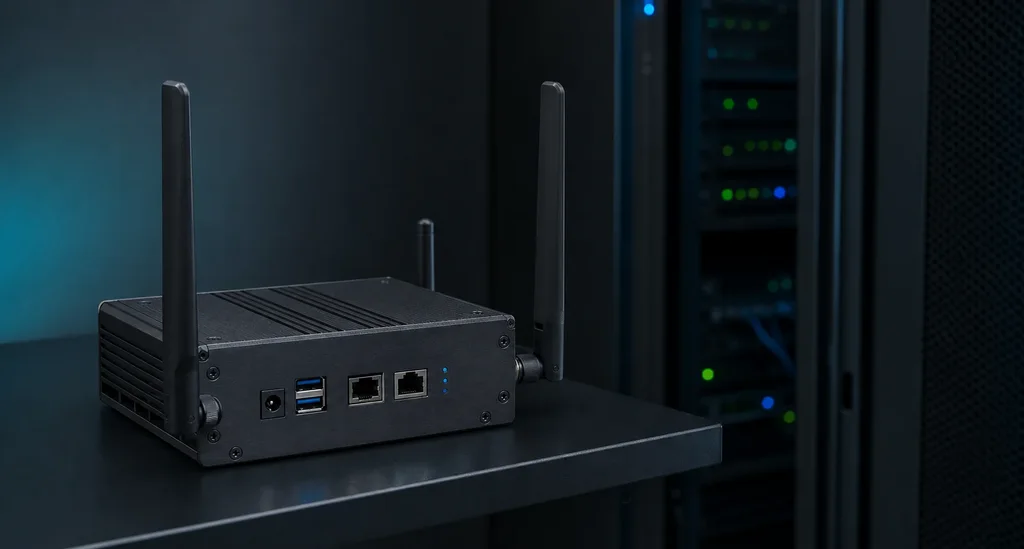
A preconfigured appliance connects your site to a governed cloud workflow. AI assists; qualified experts supervise and validate throughout.
Your offices, plant, warehouse, campus or other site — anywhere in the world — becomes the assessment environment under the agreed scope.
A Raspberry Pi-based assessment appliance, carrying the authorized wireless-testing hardware and sensors, is shipped to your designated location.
You place the appliance, connect power and any required uplink, and power it on using the short setup instructions we provide. No specialist knowledge needed.
The appliance authenticates to our cloud platform over an encrypted channel. Activity is logged and bounded by the approved rules of engagement.
A governed AI agent supports reconnaissance analysis, asset classification, target prioritization and evidence organization — within the authorized scope.
A qualified security professional oversees and validates activity throughout. AI assists; humans remain responsible for authorization and judgement.
Findings and supporting evidence are collected, correlated and reviewed against the agreed success criteria and definition of a critical vulnerability.
You receive a detailed technical PDF report and an executive presentation, with prioritized remediation and retesting recommendations.
Authorized testing capabilities
These are high-level assessment categories — not instructions. Active techniques run only when explicitly authorized.
Techniques marked “Authorized only” are performed solely when explicitly authorized in the signed rules of engagement. No technique is included in every engagement, and no active testing begins without written authorization, defined scope and agreed safety limits.
How engagements run
From authorization to reporting, each step is defined up front so there are no surprises.
We agree exactly what will be tested, how, and within what limits — before anything begins.
No testing begins until written authorization is complete.
The engagement is confirmed and the assessment appliance is prepared and dispatched.
Pricing is always scoped to your environment — we never quote a fixed price sight unseen.
Once connected, the authorized wireless environment is mapped and assessed under expert oversight.
Password-analysis activities apply only to customer-authorized authentication material and comply with the signed scope and applicable law.
You receive complete deliverables for both technical and executive audiences.
The remaining 50% is payable only when a critical vulnerability is identified, according to the definition and success criteria agreed in the signed statement of work. Final contractual language always takes precedence.
Deliverables
Every engagement produces two complementary deliverables so both technical teams and leadership can act.
Intended for: Security teamsInfrastructure teamsNetwork engineersRemediation owners
Intended for: C-suite leadersDirectorsRisk committeesNon-technical decision-makers
Why choose this service
Precise, defensible advantages — designed to reduce travel and accelerate coverage while keeping experts in control.
Assess distributed international sites without travelling to every location.
Designed to reduce lead time when many facilities need coverage.
Helps accelerate reconnaissance and evidence organization for consistent coverage.
Experts retain control of authorization, validation and risk interpretation.
Supports consistent, comparable assessments across sites and over time.
Every active technique is bounded by the signed rules of engagement.
Structured evidence collection supports remediation and audit needs.
Deliverables serve both engineers and leadership decision-makers.
Industries
Each sector faces genuine, distinct wireless exposure. We tailor scope to your operational context.
Industrial wireless links, OT/IT convergence and machine connectivity expand the attack surface across large plant floors.
Connected medical devices, mobile clinical workstations and guest access must stay isolated from patient-care networks.
Branch and corporate wireless networks carry sensitive data and face strict regulatory and segmentation expectations.
Point-of-sale, inventory scanners and public guest Wi-Fi share physical space and demand strong network segmentation.
High-density guest Wi-Fi, captive portals and property-management systems create rogue-AP and impersonation risk.
Wide-area coverage for scanners, forklifts and robotics increases exposure to rogue access points and weak segmentation.
Distributed hubs and yard operations rely on wireless connectivity that is easy to overlook in security programs.
Campus-wide networks with many personal devices and open enrolment make onboarding and isolation controls critical.
Public-sector facilities require rigorous authorization, evidence handling and segmentation of sensitive systems.
Fast-moving offices and labs frequently accumulate unmanaged access points and experimental wireless deployments.
Multi-floor and multi-site offices mix corporate, guest and IoT wireless traffic that must remain properly separated.
Utilities and essential services need careful, safety-first wireless assessment with strict stop conditions.
Headshot placeholder — replace with an approved image.
Project Leadership
Project Lead — Application, AI and Wireless Security
Ferran Verdés is an independent application-security engineer whose work spans penetration testing, threat modeling, secure architecture, code review, DevSecOps, security training, AI security, and wireless infrastructure assessment. Earlier in his career he conducted offensive security testing against wireless environments and progressed to lead wireless penetration-testing work. He has also taught IT security and Red Team concepts at university level and authored a book dedicated to Wi-Fi security, auditing, and hardening.
Frequently asked questions
A few of the most common questions. See the full FAQ for depth on scope, safety, pricing and reporting.
AI Wi-Fi penetration testing uses artificial intelligence to assist qualified security professionals with the discovery and analysis of wireless network weaknesses. It accelerates reconnaissance, classifies wireless assets, flags suspicious access points, prioritizes realistic attack paths and organizes evidence, while human experts validate findings and stay in control of all authorized testing.
No. AI supports the engagement but does not replace qualified penetration testers. Authorization, oversight, validation, risk interpretation and final reporting remain the responsibility of human security professionals. Business risk cannot be determined solely by an automated model.
Yes. A preconfigured wireless assessment appliance is shipped to your facility. Once connected, it establishes a secure, authenticated connection to our cloud platform, allowing our team to assess the on-site wireless environment remotely under the agreed scope — reducing travel while keeping human oversight throughout.
Yes, subject to applicable customs, sanctions, export, import and local regulatory requirements. Worldwide delivery is a core part of the model and lets us assess distributed international locations without on-site travel to every site.
Under the outcome-linked commercial model, the remaining balance is payable only when a critical vulnerability is identified according to the definition and success criteria agreed in the signed statement of work. Final contractual language always takes precedence.
Cost depends on the number of facilities, wireless coverage, number of SSIDs, authentication architecture, approved techniques, social-engineering scope, shipping, reporting and retesting requirements. Request a quote and we will prepare a scoped proposal for your environment.
Request a quote
Share three details and we will follow up to scope your engagement. No account, no password.
Prefer a dedicated page? Visit Request a Quote.
A member of our team will follow up to scope your engagement. You will also receive a short confirmation email shortly. If it does not arrive, please check your spam folder.
Request a scoped Wi-Fi security assessment for a single facility or a distributed international environment.
All testing is conducted under written authorization and an agreed scope.